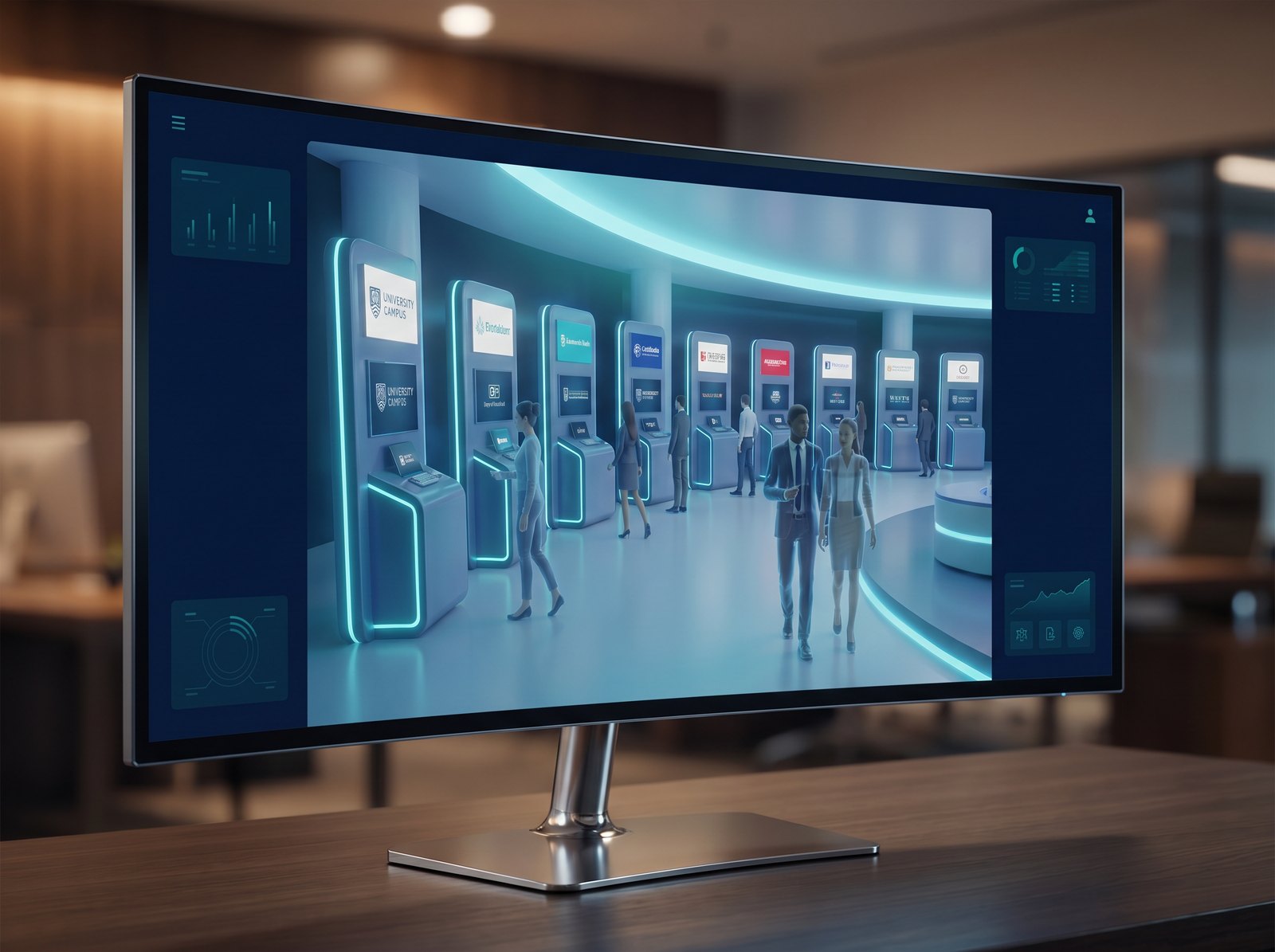
EasyVirtualFair is the platform of choice for 150+ universities worldwide. Attract more recruiters, double attendance over physical fairs and give every student — on-campus or remote — equal access to your career services.
The traditional in-person career fair — folding tables in a gym, branded pens, a line of students in business attire — is not dead. But it no longer reaches the students universities are trying to serve. Commuters, online learners, international students, graduate students, military veterans, students with disabilities and students balancing part-time jobs all face friction attending a single in-person event held in a single building on a single afternoon.
A well-run virtual career fair removes that friction. Students join from a laptop or phone, browse employer booths, watch live presentations, drop their CV and book a 1-on-1 chat — all without missing class, paying for parking or commuting two hours. According to the National Association of Colleges and Employers (NACE), more than half of students attended at least one career fair in the past 12 months — and the share attending virtual events has grown every cycle since 2020.
EasyVirtualFair is the platform of choice for 150+ universities worldwide, from R1 research institutions and Ivy-adjacent privates to community colleges and graduate schools. This guide explains why, with sourced numbers, six concrete use cases, KPIs, a 12-point planning checklist, budget benchmarks and a practical FAQ.
The numbers behind university career fairs
If you're justifying a virtual career fair budget to a dean, provost or board, these are the figures that matter most.
50%+of US college students attended a career fair in the last 12 months (NACE 2024)
87%employment rate for 25-34 year-olds with a bachelor's degree (NCES 2023)
2–3×typical attendance lift vs in-person fairs at EVF universities
$1,500starting price per virtual fair on EasyVirtualFair
The picture is consistent across the data: career fairs remain a central touchpoint between students and employers, but format matters. National Center for Education Statistics (NCES) data shows that bachelor's degree holders earn measurably more, are employed at higher rates, and that employment outcomes increase with each level of educational attainment — meaning the work of Career Services has a direct, measurable lifetime impact on students.
The 2024-25 NACE Career Services Benchmarks Report also documents how career services offices are increasingly measured on employer engagement, equitable access and post-graduation outcomes — all areas where a virtual or hybrid fair delivers measurable gains.
Six high-impact use cases for higher ed
Universities don't run one type of event. They run a calendar of recruitment touchpoints throughout the academic year. Here are the six formats where a virtual platform creates the most lift.
1. The flagship fall career fair
The traditional September or October all-college fair, opened to every major. Run as a hybrid event — physical booths on campus, virtual booths for remote employers and commuter students — you triple your reach. Employers who couldn't justify a flight to your campus can still send three recruiters. International alumni can mentor seniors. Students stuck in afternoon labs can drop in between classes.
2. Industry-specific career weeks
Tech Week, Healthcare Week, Finance & Banking Week, Engineering Week, Education & Nonprofit Week. A 5-day virtual format lets you split recruiters by sector, run themed panels each evening, and give every cohort dedicated attention. Marketing a multi-day virtual fair is also easier — you can run an email drip, a daily LinkedIn post and a weekly student newsletter feature.
3. Graduate, MBA and PhD recruiting days
Graduate-level recruiting works very differently from undergrad. Smaller cohorts, much higher offer values, more 1-on-1 conversations. A virtual booth with private chat scheduling and a 30-minute "office hours" format outperforms a crowded in-person fair — and it's the only realistic way to get global recruiters into the same room as your PhD candidates.
4. Alumni networking & mentorship nights
Your alumni network is one of your most underused recruiting assets. A virtual "alumni night" — where graduates host informational booths organized by industry — gives current students access to senior professionals at firms that don't formally recruit on campus. See our alumni engagement playbook for the full format.
5. Pre-orientation employer expo for admitted students
Run a virtual expo for admitted students in July or August — before they arrive on campus. It signals that your university takes career outcomes seriously, helps students preview career services, and gives admissions a yield-influencing differentiator versus competing offers.
6. Open days and applicant-to-employer signal events
Universities can use the same platform for non-recruiting open days, including admissions fairs and program info sessions. Many institutions run a single annual contract that covers career events, admissions virtual events and alumni programming.
See the platform in action
A 20-minute demo with a Project Manager who has run 200+ university fairs.
Formats: open day, career week, alumni night, employer expo
One mistake universities make: copying their physical fair format directly into virtual. A 3-hour, single-day, browse-the-booths layout doesn't translate. The best-performing virtual formats are:
Multi-day with daily themed sessions — 5 days, one industry per day, evening webinars, on-demand content for two weeks after. Average student attendance is 3–4× a single-day equivalent.
"Always-on" employer expo — A persistent virtual lobby open year-round, with featured employers rotating monthly. Students browse asynchronously and book chats. Works well for community colleges and large state systems.
Curated 1-on-1 scheduler day — No browsing. Career Services pre-matches students to recruiters based on declared major and interests. Highest-quality interactions, ideal for graduate programs.
Hybrid in-person + virtual — Physical booths run during business hours, virtual booths run an evening session for commuters. Effectively doubles your fair.
KPIs every Career Services office should track
If you can't measure the fair, you can't defend the budget. Here are the metrics every Career Services office should pull from their platform analytics — and what "good" looks like benchmarked against EVF data.
KPI
What it measures
Good benchmark
Registration rate
% of invited students who register
15–25% of eligible student body
Show-up rate
% of registrants who actually attend
55–70% (virtual outperforms physical here)
Booth visits per attendee
Average booths a student visits
4–7 per session
CV downloads per employer
Recruiter pipeline volume
15–40 per booth at a mid-size fair
1-on-1 chats scheduled
High-intent interactions
2–6 per recruiter per day
Post-fair offer rate
Students with offers within 90 days
15–25%, highly major-dependent
Employer NPS
Would you recruit here again?
50+ is excellent
Cost per student interaction
Event cost / total interactions
$3–$10 on virtual; $25+ on physical
The cost-per-interaction line is where virtual fairs win the budget conversation. A physical fair with 600 students and a $25,000 all-in cost (venue, catering, staffing, signage) yields ~$42 per student. A virtual fair on EVF with 1,800 students and a $2,500 cost yields ~$1.40. That gap is the entire ROI argument in one number.
12-point planning checklist for a university career fair
This is the checklist EasyVirtualFair Project Managers use with new university clients. Print it, share it with your dean, work through it.
Define the audience — All-college, college-specific, graduate-only, alumni-included, admitted students only?
Pick the format — Single day, career week, always-on, hybrid. See "Formats" above.
Lock the date — Avoid finals, midterms, religious holidays, athletic event nights and the day after spring break.
Set employer recruitment goals — Number of booths, target industries, alumni representation, DEI commitments.
Build the employer outreach list — Last year's attendees + alumni-employer database + 50 new targets.
Design the lobby — Branded with your colors, campus imagery, accessible color contrast.
Configure booths — One per employer, with video, brochures, job listings, chat queue, scheduling link.
Run the day — Live help desk staffed by Career Services, with EVF on standby.
Capture analytics — Export every report within 48 hours of close.
Post-fair follow-up — Send students recordings, follow up with employers on NPS, plan next event.
Real examples from EasyVirtualFair clients
A few anonymized snapshots from recent university clients on the platform:
A mid-Atlantic R1 university ran a 3-day Tech & Engineering virtual fair: 87 employer booths, 3,200 student visits, 412 CV downloads per employer on average, and 11 confirmed full-time offers within 30 days.
A Spanish public university ran a bilingual career fair targeting US employers seeking Spanish-speaking talent: 42 employers, 1,100 students, with EVF supporting the event in both English and Spanish from a single lobby.
A US community college consortium ran an "always-on" virtual employer expo across 6 partner colleges: 60+ employers rotating monthly, 8,500 student visits across the academic year, single shared contract.
An MBA program at a top-30 business school ran a 90-minute MBA-only recruiter day with 22 firms and 95 students. Pre-matched 1-on-1 chats only. 60+ offers extended within the next 60 days.
Branded EVF vs Handshake fairs: what changes
This question comes up in almost every demo. The honest answer: most universities use both. Handshake is excellent for ongoing job postings and the always-on student-employer matching layer. EasyVirtualFair is built for the flagship branded event — the moment where your career services brand, your campus identity and your employer relationships are on display.
What does a virtual career fair cost? Real numbers from the platform and from public RFPs across higher ed:
EasyVirtualFair per-event: from $1,500 per event, scaling with number of booths and feature set. See the employer guide for detailed pricing.
Handshake bundled fair feature: included in school license, but with limited customization and restricted to Handshake-registered employers.
vFairs / Brazen / CareerEco: typically $5,000–$25,000 per event depending on scale (see our comparison).
Annual virtual platform contract: $5,000–$50,000+ for unlimited events, depending on vendor.
The ROI math: a $2,500 virtual fair that generates 200 student-employer interactions costs $12.50 per interaction. A $25,000 physical fair generating 500 interactions costs $50 per interaction — a 4× difference. Multiply by the number of fairs you run per year and the case writes itself.
Get a per-event quote tailored to your university
Tell us about your event size and format. We'll send a written quote within 24 hours.
Virtual career fairs are often the most accessible format your career office can offer. Students with mobility disabilities, students with chronic illnesses, neurodivergent students who find crowded physical fairs overwhelming, students caring for family members, and students who can't afford professional clothing all benefit from a format that meets them where they are.
That said, accessibility isn't automatic. Universities should check that their virtual platform meets WCAG 2.1 AA standards, that captions are available on live sessions, that screen readers work in the lobby and booths, and that international students with slower connections can join without video forced on. EasyVirtualFair is browser-based, mobile-first and tested against WCAG; see our accessibility guide for what to ask any vendor.
Equity also has a Title IX dimension: a virtual format reduces the in-person dynamics that contribute to harassment complaints at physical career fairs, while platform analytics give Career Services a record of every interaction — useful for compliance, reporting and continuous improvement.
Frequently asked questions
How long does it take to set up a virtual career fair for a university?
Most universities go live in 2–4 weeks. EasyVirtualFair offers a dedicated Project Manager during setup and the platform is fully managed — career services staff don't need IT support to launch.
Can students join from a mobile phone with no app download?
Yes. EasyVirtualFair is 100% browser-based. Students join from any device — laptop, tablet or phone — without installing anything. This is critical for commuters, online students and international applicants.
How does it integrate with Handshake, Symplicity or our existing CMS?
EasyVirtualFair runs alongside Handshake and Symplicity. We provide a single registration link you can embed in your existing platforms, your CMS (WordPress, Drupal, etc.), Canvas, Blackboard or email campaigns. Many universities use EVF for their flagship branded fair while keeping Handshake for ongoing job postings.
How many recruiters can attend at once?
There is no hard cap. EasyVirtualFair supports hundreds of recruiter booths and thousands of concurrent students in a single event. The largest university fairs on the platform have hosted 20,000+ employers and 5,000+ student visits in a single day.
Can we run an alumni-only or graduate-only fair?
Yes. You can restrict access by email domain, ticket code, year of graduation or program. Many institutions run alumni-only events, MBA recruiting fairs, PhD-level industry days and international student-only sessions on the same platform.
Do you support multi-language fairs?
Yes. The platform interface ships in English, Spanish and French out of the box, and additional languages can be added for the lobby, booth descriptions and resource library. We power bilingual fairs across the US, Spain and LATAM.
How is student data protected (FERPA, GDPR)?
EasyVirtualFair is GDPR-compliant, runs on EU and US infrastructure with role-based access, and signs Data Processing Agreements with every university client. Student PII is never sold or shared with third parties. Recruiters only see what students choose to share when they visit a booth.
Can recruiters export student leads after the event?
Yes. Each recruiter can download a CSV of every student who visited their booth, downloaded their materials or scheduled a 1-on-1 chat. Career Services receives the master export across all booths.